
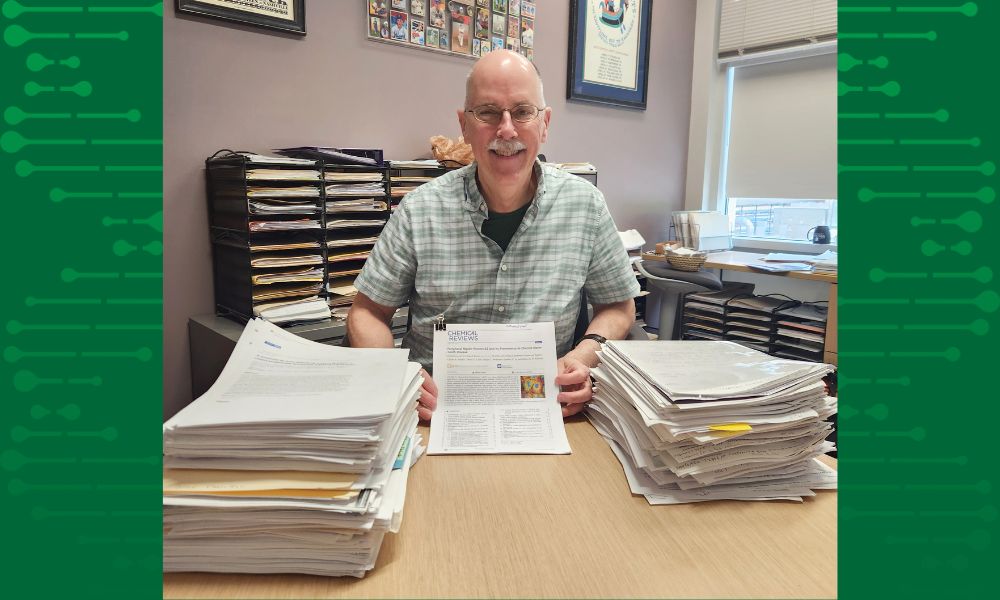
Dr. Charles R. Sanders featured next to stacks and stacks of papers incorporated into the review.
A major new scientific review published in Chemical Reviews has assembled the most comprehensive account to date of peripheral myelin protein 22 (PMP22), the protein responsible for over half of all CMT diagnoses.
Led by Dr. Charles R. Sanders and Dr. Bruce Carter at Vanderbilt University, CMTRF funded partners and advisors, the 42-page paper draws on over 450 references and spans more than 30 years of research.
What Is PMP22 and Why Does It Matter?
PMP22 is a protein produced by Schwann cells, the support cells that wrap peripheral nerve fibers in myelin. Genetic changes affecting PMP22 account for more than half of all CMT cases in western populations. CMT1A, the most common form, results from having one extra copy of the PMP22 gene while CMT1E results from mutations that alter the protein’s shape. HNPP results from having only one working copy instead of the usual two. Three distinct diseases, all tracing back to one protein.
What the Review Covers
The paper covers the structure and function of PMP22, how it moves through cells, how that process breaks down in disease, and the current landscape of potential treatments, from gene therapy and antisense oligonucleotides to small molecule drug candidates that could correct PMP22 misfolding.
There are no approved treatments for any form of CMT. This review maps the key obstacles and identifies the most promising paths forward, while calling for greater engagement from chemists and chemical biologists whose tools have only begun to be applied to this challenge.
For researchers, this paper functions as both a field map and a call to action.
For patients and families, its publication in one of the world’s most prestigious scientific journals signals that CMT is being taken seriously at the highest levels of science, and that the knowledge base needed to find treatments is more organized than it has ever been.