
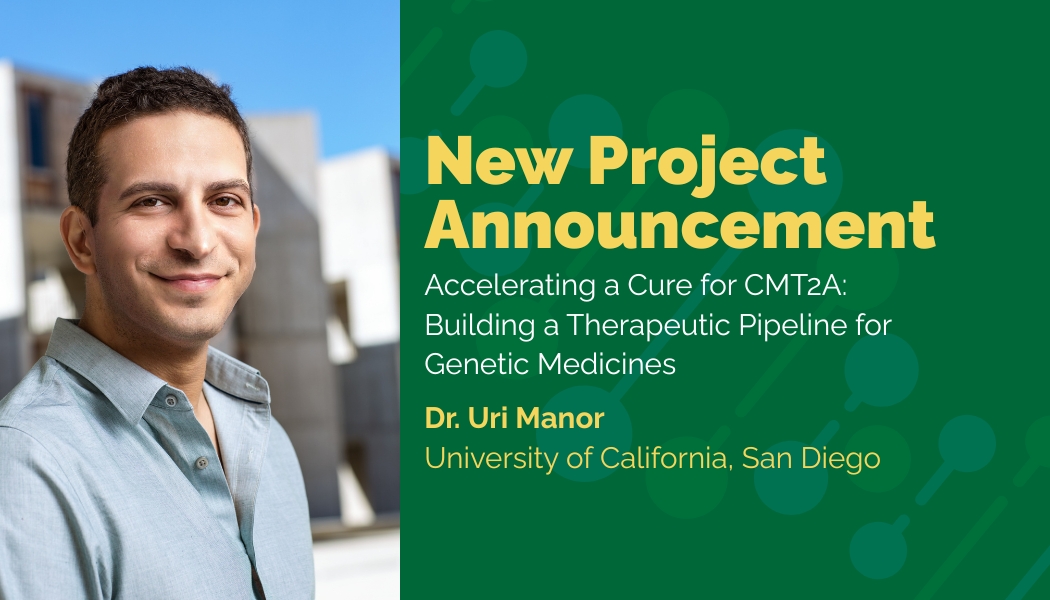
The CMT Research Foundation has funded a new study at University of California San Diego led by Dr. Uri Manor to build an end-to-end pipeline for finding and validating a genetic treatment for CMT2A.
CMT2A is a progressive disease caused by mutations in a gene called MFN2, which encodes a protein that is important for maintaining the energy supply along the entire length of nerves. When MFN2 is faulty, energy is not distributed efficiently and the nerves that control movement and sensation gradually stop working. Unfortunately, many CMT2A patients are severely impacted during early childhood, making the search for a validated lead therapy a particularly urgent, time-sensitive endeavor.
CMT2A is the most common form of CMT type 2, the form of CMT that primarily affects the neuron itself rather than the protective coating around it. Beyond direct impact, the tools this project builds are designed to be reusable: researchers working on other subtypes could adapt the same approach to accelerate their own path toward clinical trials. That means a successful treatment for CMT2A could accelerate the development of therapeutics across CMT subtypes in the future.
What makes developing a treatment for CMT2A especially hard is that >100 different MFN2 mutations can cause the disease. Until now researchers have not had a reliable way to tell whether a therapy is actually making a difference inside the cell. Dr. Manor’s project is designed to solve that.
The team will begin by reprogramming skin cells into nerve cells from CMT2A patients. Dr. Manor and his team will use AI-enhanced microscopes to identify a consistent “fingerprint” of the disease: the specific patterns of cellular damage that show up regardless of which MFN2 mutation a patient carries. Once identified, these markers become the benchmark for success for new therapeutics. The team plans to test genetic medicines that silence the faulty MFN2 gene in the patient-derived cells to find out which works best. The strongest candidate will then be tested in pre-clinical models that carry the same human MFN2 mutations.
“CMT2A patients have waited too long for solutions, making this a critical and urgent unmet need. This new pipeline is designed to strip the guesswork out of therapeutic development. By pairing rigorous biomarker discovery with head-to-head comparisons of genetic medicines, we aren’t just looking for clues – we are actively isolating the single, most powerful candidate to advance into clinical trials.” — Dr. Uri Manor, UC San Diego
By the end of the three-year project, the team expects to have both a validated lead therapy and a suite of reliable biomarkers to measure its effect, giving the broader CMT2A research community a clear, evidence-based path toward potential treatments.